
Health Equity North directors respond to Child Poverty Strategy announcement


“The Government’s Child Poverty Strategy marks an important moment in the fight against child poverty, and we welcome its ambition to tackle some of the most pressing challenges facing families today. The commitments to improve childcare access, strengthen family hubs, and invest £400 million in school-based nurseries – 10% of which will be in the North East – are positive steps that reflect priorities we have long advocated for. Measures to address homelessness, including ending unlawful placements in bed and breakfasts beyond six weeks, an overhaul of the child maintenance service systems, and plans to review infant formula regulations to ease costs for families, are also hugely encouraging.
“However, our research at Health Equity North shows that 34% of children in the North live in poverty compared to 28% nationally – and this gap is widening. Poverty does not just stay in childhood – it is experienced drastically across the life course, and our leaders have a small but important window of opportunity within to address drivers, through meaningful change, in all aspects of a child’s life. Without bold, central government action to close those stark regional disparities, the cycle of poverty will persist for generations. The strategy also lacks a clear plan to address systemic drivers of poverty in minority ethnic households, which experience disproportionately high rates of deprivation.
“While the strategy rightly focuses on early years, given that nearly half of households in poverty have a child aged 0–5, leaders must remember to ensure older children are not left behind. Our ‘Addressing Education and Health Inequity: Perspectives from the North of England’ report shows that schools in deprived areas are receiving less funding than those in the most affluent areas – and increases are lower in poorer areas. This, coupled with household poverty, means that children in those deprived areas continue to have lower educational attainment, and are leaving school with fewer GCSE and A-Level results. We continue to call for reviews of the National Funding Formula to create fairer allocations, as well as targeted interventions to close the education gap where it is needed most.
“Whilst today’s strategy, coupled with the impending removal of the two-child benefit cap, is a significant step in the right direction, we urge the Government to go further: invest in education across the whole school system, tackle regional inequalities head-on, and ensure that every child – regardless of where they live, their background, or their circumstances – has the opportunity to thrive. Child poverty is not just a social issue; it is a public health crisis that affects life chances, health outcomes, and economic productivity through to adulthood. The time for incremental change has passed – we need bold, coordinated action that matches the scale of the challenge.”
Hannah Davies, Executive Director of Health Equity North and Chief Executive of the Northern Health Science Alliance
Professor David Taylor-Robinson, Academic Co-Director of Health Equity North, and Professor of Public Health and Policy at the University of Liverpool
Dr Luke Munford, Academic Co-director of Health Equity North and Senior Lecturer in Health Economics, The University of Manchester
Professor Clare Bambra, Academic Co-director of Health Equity North and Professor of Public Health at Newcastle University
Professor Kate Pickett, Academic Co-Director of Health Equity North and Professor of Epidemiology, University of York
Related News Stories
“The Government’s Child Poverty Strategy marks an important moment in…

By Head of Public Affairs Alexis Darby The Chancellor Rachel…
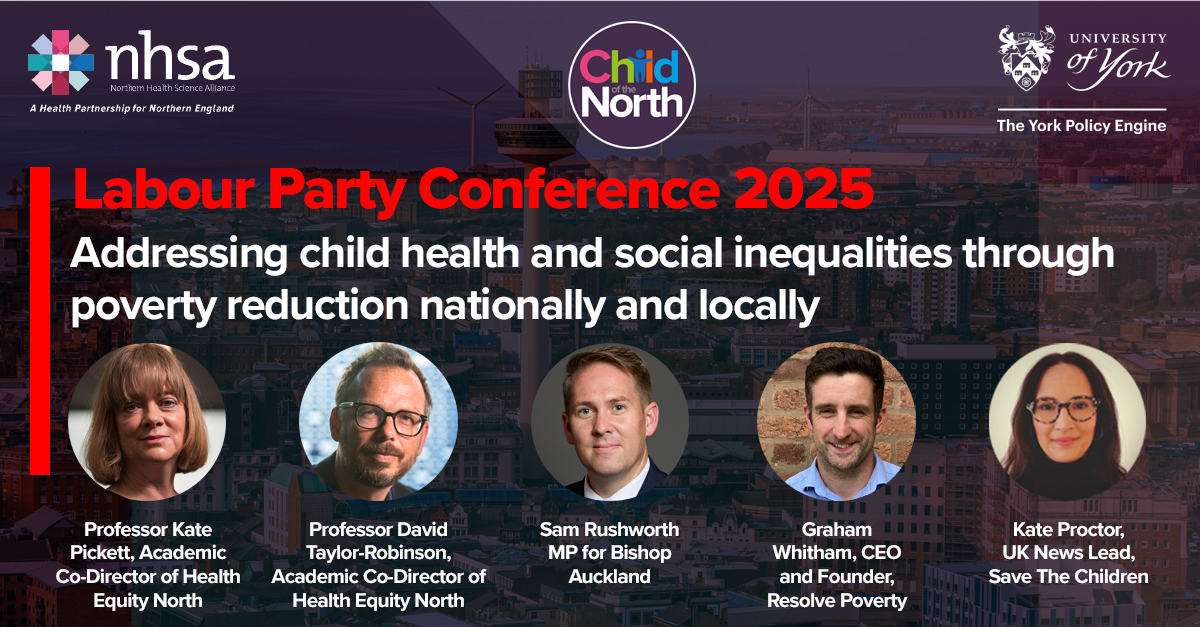
In September 2025, we held a panel event at the…



