
HEN Academic Co-Director comments on new ‘Young people and work’ report



A new government-commissioned report, authored by the Rt Hon Alan Milburn, assesses why so many 16-24 year olds are not in education, employment or training (NEET), arguing that Britain is facing a “lost generation” crisis.
The ‘Young people and work: interim report’, a predecessor to a report that will come out later this year, has found that nearly 1 million young people in the UK are currently NEET, about 1 in 8 young people. This is a challenge that bridges education, skills, health, employment, and welfare systems.
The report urges that this is not a case of an attitude problem amongst young people, but structural barriers that are limiting the ability of many to find, or be ready for, work. The risks of becoming NEET are not evenly distributed, but further exacerbated by factors including low attainment, poor health and limited family resources.
Commenting on the report, our Academic Co-Director, Dr Luke Munford, said: “This review is another stark warning that far too many young people are being locked out of opportunity, with serious consequences for their health, wellbeing and future life chances. Health Equity North’s research has consistently shown that young people who are not in education, employment or training (NEET) face significantly worse health outcomes, including poorer mental health, lower lifetime earnings, and greater risk of long-term disadvantage. These inequalities are not inevitable – they are shaped by the environments in which children and young people grow up.”
“Our research shows that NEET rates are highest in communities already facing entrenched deprivation, particularly across parts of the North of England, where economic insecurity, poor housing, lack of access to services and reduced opportunities combine to limit young people’s futures. Preventative action is critical – and the evidence is clear that early intervention works. Supporting children and young people before they reach crisis point, through better mental health support, stronger schools and colleges, secure employment pathways, and targeted local investment, delivers long-term benefits not only for individuals, but for the wider economy and population workforce. This cannot be treated simply as a labour market issue – it is also a health equity issue. If the government is serious about improving productivity, reducing pressure on public services and giving young people the chance to thrive, tackling the root causes of youth disengagement must be a national policy priority.”
Read the interim report here.
Related News Stories

On Wednesday October 7, 2026, Health Equity North supported two…

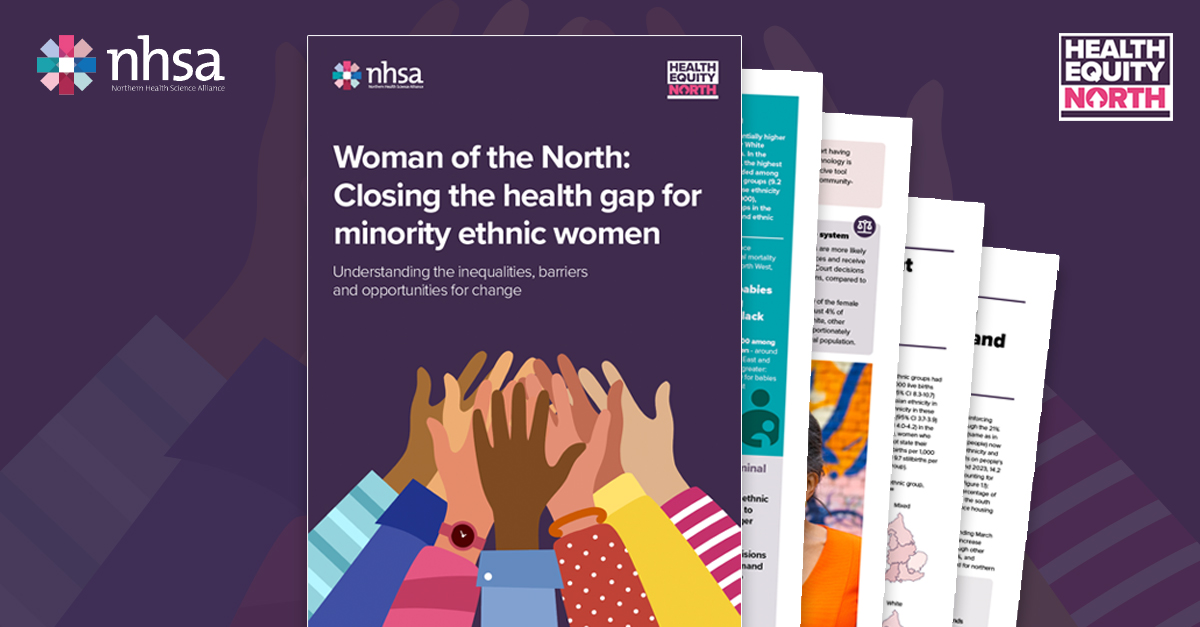
Minority ethnic women in the North of England face a…

The Government has announced the rolling out of a Healthy…



